Home » Lead Qualification Engine
Qualifying incoming leads and increasing conversion rates is the biggest challenge for businesses.
This process is very important for increasing the productivity of the sales team and boosting the company's results.
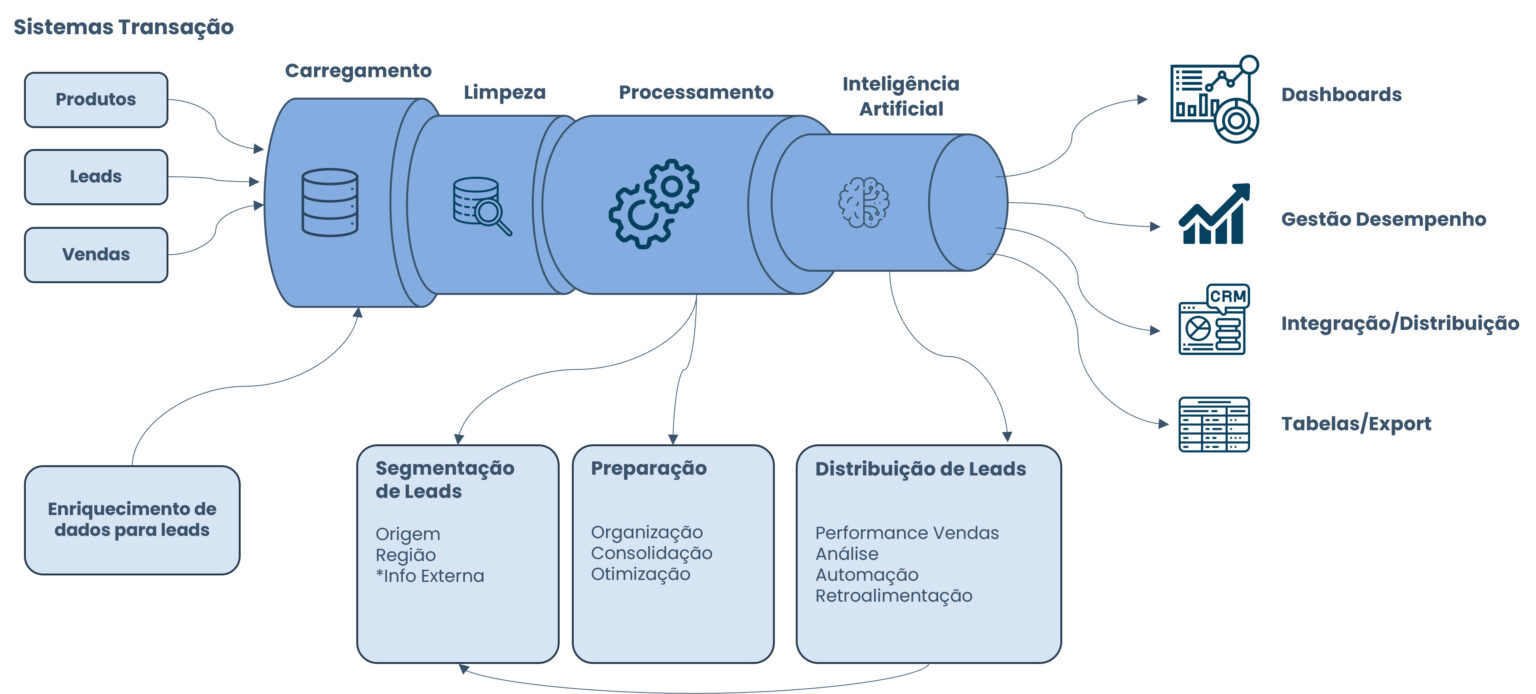
With a team of Data Science experts and utilizing Artificial Intelligence and advanced Machine Learning techniques, Lumini has developed a cognitive engine capable of segmenting and qualifying business leads.
Data Science & AI
FEATURES
Through this journey, we use models to segment potential customers and recommend products and services according to each profile, prioritizing conversion rates.
It is an algorithm used to assign a score to potential customers based on their likelihood of conversion into sales. It is developed using historical sales data and contact information, such as: demographic characteristics, purchasing behavior, and interactions with the company.
Algorithm used to recommend items (such as movies, music, books, products, and services) to users based on their previous preferences and consumption behaviors.
It is capable of analyzing and processing large amounts of data, identifying patterns and relationships between items and users, and then recommending relevant and personalized items for each.
Algorithm used to represent groups of individuals who share similar characteristics, such as behaviors, needs, goals, and challenges.
It is used to better understand the target audience, personalize marketing messages, optimize the user experience, and develop new products and services. The Persona model is created based on qualitative and quantitative data, including interviews, market research, and behavioral data analysis.
It is an algorithm used to identify relationships between individuals based on data collected about them. It can be used to recommend friends, suggest sellers to customers, enable professional networking, and more.
The model uses Machine Learning techniques to analyze data such as interests, activities, relationship history, etc., to find individuals who have similar, and therefore compatible, characteristics.
We use Machine Learning techniques, such as Logistic Regression, Random Forest, among others, to predict the probability of a lead becoming a qualified customer, based on historical and behavioral characteristics.
We perform exploratory data analysis on contacts using tools like Power BI or Tableau to identify trends, patterns, and opportunities.
We apply Machine Learning models, such as Linear Regression or Random Forest, to predict the purchase propensity of potential customers.
We implemented a contact scoring system, using tools like KNIME or RapidMiner, to prioritize those with the highest conversion potential.
We use behavioral analysis techniques, such as clustering or PCA, to understand user behavior in relation to certain products or services.
We use genetic algorithms or particle swarm optimization to optimize marketing campaigns, increasing efficiency and ROI. Optimization can include adjustments to target audience, marketing message, sending timing, delivery channel, and other campaign aspects.
We apply Machine Learning models, such as Naive Bayes or SVM, to classify leads into different segments, according to their characteristics and behavior.
We implement personalization techniques, such as content-based or collaborative filtering recommendation, to offer leads a personalized and relevant experience.
We use natural language processing tools, such as NLTK or spaCy, to analyze leads' opinions on certain products or services.
We implemented a real-time monitoring system, using technologies like Apache Spark or Flink, to track lead behavior in real-time.
We consult credit bureaus and other sources to supplement missing data and provide accurate and up-to-date information on leads. This includes information such as updated phone numbers, personal documents, marital status, family income, among others.
We use statistical techniques to identify patterns and trends among leads, allowing for more precise market segmentation.
We use linear regression models, decision trees, Random Forest, and other techniques to predict future sales based on collected lead information.
We use data mining and Machine Learning techniques to identify lead purchasing patterns and behaviors, helping to personalize marketing and sales campaigns.
We use statistical techniques to predict the value of a lead over time, taking into account their likelihood of remaining a customer and their purchase value.
We use clustering techniques, such as K-Means, to group leads based on their similar characteristics, such as demographics, purchasing behavior, and interests, to identify patterns and segment the target audience.
We apply regression models, such as Linear and Logistic Regression, to predict lead behavior in relation to sales conversion.
We utilize data mining techniques, such as Logistic Regression and Decision Trees, to identify groups of leads with similar purchasing potential. This allows marketing actions to be targeted more efficiently and effectively.