Home » Churn Prediction Engine
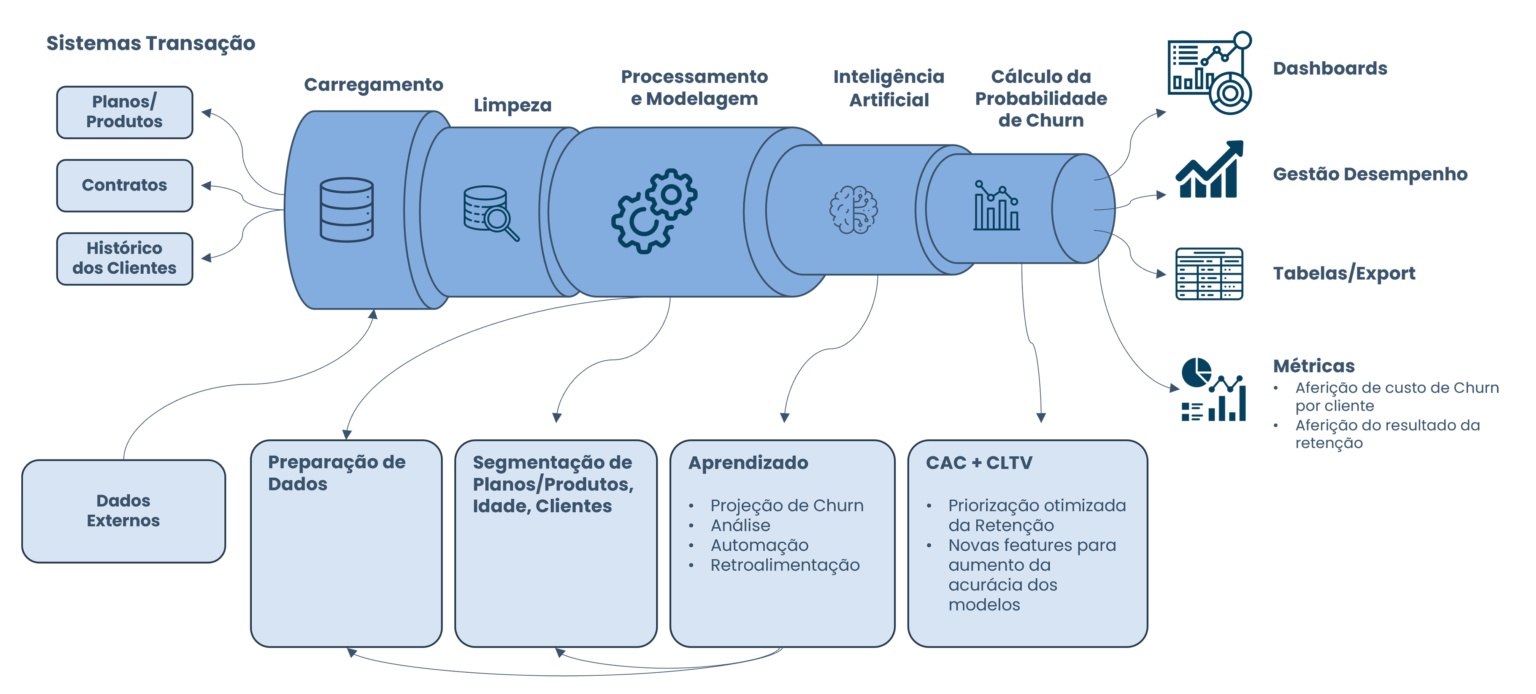
Calculating the probability of churn is an important process for a business's strategy. It helps responsible teams develop an action plan capable of retaining the most strategic customers and optimizing investments with marketing campaigns, for example.
With a team of Data Science specialists and utilizing Artificial Intelligence and advanced Machine Learning techniques, Lumini has developed a cognitive engine capable of predicting individuals with a higher likelihood of churning as customers.
Data Science & AI
FEATURES
Through a Retention journey, we use models to identify patterns and trends of customers most likely to churn.
This is a predictive algorithm used to identify individuals or companies with a high probability (risk) of not fulfilling their financial obligations, such as debt or loan payments. It is generally built from historical payment data and other relevant information, such as income, credit, and payment history.
It is a Machine Learning algorithm that seeks to identify, based on patterns, customers who are late on payments but have the potential to regularize their debts without external intervention. This way, it is possible to prioritize collection actions for customers who truly need external intervention and give more time to customers who have the potential to regularize their debts.
This is an algorithm that investigates customer conditions before service cancellation, using historical data to identify cancellation-related patterns. It does not follow a timeline but rather calculates the probability of cancellation based on the customer's current characteristics (late payments, open requests, satisfaction, etc.) using machine learning. The objective is to determine patterns between these characteristics and the cancellation patterns learned from historical data.
Algorithm that evaluates customer behavior during service usage, using historical actions (tickets, payments, support interactions, delays, data changes, etc.) to identify characteristics related to service cancellation. Machine learning is used to detect behavioral patterns that may lead to customer churn. When a pattern is detected, a timestamp is associated with the customer as a prediction of when they will cancel the service, which is updated as more patterns are detected.
Estimate the probability of a customer canceling or not renewing their service or product. This can be done using techniques such as Logistic Regression, Random Forest, or XGBoost.
Identify the main reasons why customers cancel their services or products. This can be done using Multiple Correspondence Analysis, Cluster Analysis, or Principal Component Analysis techniques.
Monitor churn in real time and identify opportunities to intervene and prevent cancellation. This can be done using batch processing or real-time processing techniques.
Identify actions customers can take to resolve their issues without needing customer service. This can be done using Multiple Correspondence Analysis, Cluster Analysis, or Principal Component Analysis techniques.
Estimate the probability of a customer not paying their debts. This can be done using techniques such as Logistic Regression, Random Forest, or XGBoost.
The objective of this service is to identify the reasons why customers are not paying their debts. This can include lack of financial resources, platform issues, problems with the product or service offered, among others. Some techniques that can be used include textual data analysis, log analysis, regression models, decision trees, and clustering.
This service focuses on predicting whether a delinquent customer can recover on their own. This can be useful for the Company to identify which customers need additional assistance to resolve their financial issues.
This service focuses on understanding the customer's journey before, during, and after delinquency. This may include information on payment behavior, platform usage, customer support interactions, and other relevant information.
Identify patterns and trends that can help prevent late or missed payments by customers. Some techniques that can be used include: Classification Models, Sequence Rule Association Analysis, and Time Series Analysis.
This service aims to track customer delinquency in real-time and identify customers at risk of delinquency. Tools such as interactive dashboards, based on technologies like PowerBI or Tableau, can be used to visualize delinquency data and quickly identify which customers have overdue accounts.
Used to identify customers who are most likely to cancel their contract or stop being a customer. It's important to conduct proactive churn analysis so the company can take preventative measures.
This analysis aims to identify the common characteristics of customers who are more likely to cancel their contracts or stop using the Company's services. This can be done using data mining techniques such as clustering, classification, or discriminant analysis.
Identify patterns or trends in customer behavior over time. This can be useful for identifying times when customers are most likely to churn.
Predictive modeling is a data science technique that uses algorithms to predict the outcome of a variable of interest, based on historical data. This technique can be used to predict the probability of a customer's default, churn, or self-cure.
Cluster analysis is a data analysis technique that helps identify groups of similar objects. This technique can be used to identify groups of customers with similar behaviors regarding churn, default, or self-cure.
It is a statistical analysis that seeks to understand the relationship between two or more variables. It is possible to identify, for example, if there is a relationship between customer loyalty and the use of certain products or services.
It is a statistical analysis that seeks to predict the value of a variable from other independent variables. This technique can be used to predict the probability of a customer defaulting, for example.
It is a technique that seeks to understand the relationship between various variables and, based on that, make decisions. It is possible to use decision modeling to identify which actions are most effective for preventing churn or stimulating self-cure.
It is a machine learning technique that seeks to create models from data to predict future outcomes. Machine Learning can be used to predict the probability of churn, for example.
Collect and analyze data related to customer interactions with the Company (phone calls, chats, emails, etc.). The analysis may include information on contact frequency, duration, reason, and customer satisfaction.
This helps the Company understand how customers are interacting with the business and identify patterns that could indicate churn or default risk.